
Japanese-Peruvian · Appetizers & Sides
Pepper-Seared Salmon with Mustard Miso Sauce
A Home Version of the Chef’s Special
Serves 4 · Prep: 25 minutes · Cook: 20 minutes · Total: 45 minutes
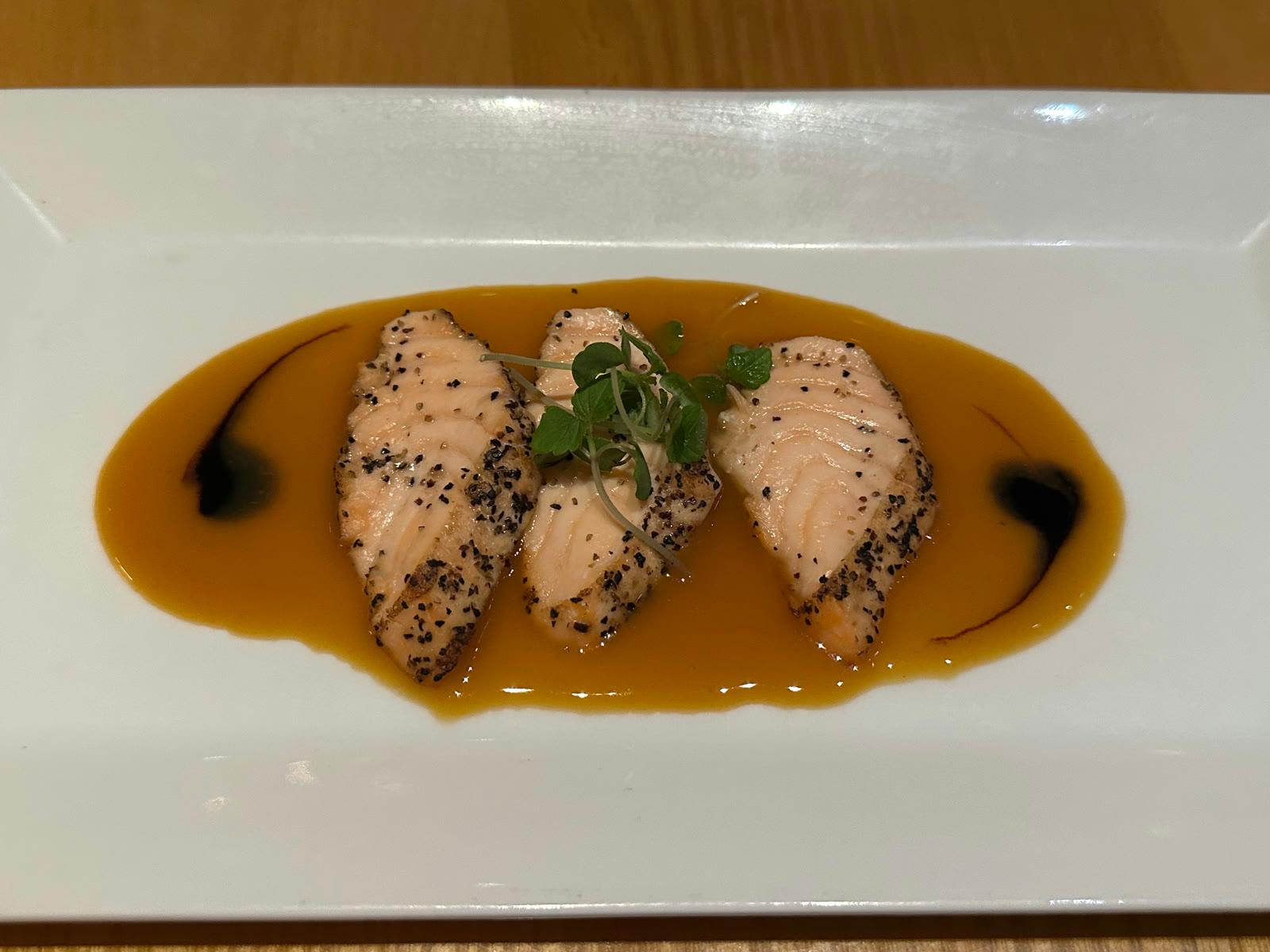
The mustard is noticeable here, even through the richness of the salmon. White miso gives the sauce some sweetness, while the vinegar keeps it sharp. Use the soy-balsamic reduction sparingly; a few drops add plenty of salt and sweetness.
The salmon cooks through in a low oven before a brief sear to darken the pepper. That leaves less time spent turning a delicate fillet in a hot pan. Choose a thick, even piece and check that the center reaches 145°F with a thermometer. Spoon the sauce onto the plate first so the peppered surface stays uncovered.
Ingredients
For the mustard miso sauce
- 3 tablespoons white miso
- 2 tablespoons unseasoned rice vinegar
- 1 tablespoon mirin
- 1 tablespoon yuzu juice or fresh lemon juice
- 2 teaspoons Japanese hot mustard or Dijon mustard
- 1 teaspoon sugar
- 2 to 3 tablespoons water
For the soy-balsamic reduction
- 2 tablespoons balsamic vinegar
- 1 tablespoon Japanese soy sauce
- 1 teaspoon honey
For the salmon
- 1 pound center-cut skinless salmon fillet, about 1½ inches thick
- ¾ teaspoon kosher salt
- 1½ teaspoons coarsely cracked black pepper
- 1 tablespoon neutral oil
- ½ cup peppery microgreens or baby watercress
Instructions
- 1
Make the mustard miso sauce
Whisk the miso, rice vinegar, mirin, yuzu juice, mustard, sugar, and 2 tablespoons water until smooth. Add the last tablespoon of water if needed; the sauce should settle into a spoon-shaped puddle rather than hold a peak. Set it aside at room temperature.
- 2
Reduce the soy and balsamic
Put the balsamic vinegar, soy sauce, and honey in the smallest saucepan you have. Simmer over medium-low heat for 3 to 5 minutes, until it lightly coats a spoon. Take it off the heat before it looks syrupy; it thickens as it cools.
- 3
Slow-roast the salmon
Heat the oven to 300°F. Pat the salmon dry and season all over with the salt and cracked pepper. Set it on a parchment-lined sheet pan and roast for 12 to 18 minutes, depending on thickness, until the center reaches 135°F to 140°F. Rest for 5 minutes, then check again. If it has not reached 145°F, return it to the oven briefly.
- 4
Sear the peppered edges
Heat the neutral oil in a well-seasoned cast-iron or nonstick skillet over medium-high heat. Add the salmon and sear for 20 to 30 seconds on each broad side, just long enough to darken the pepper. Move it gently with two spatulas; cooked salmon is not interested in staying in one piece for your convenience.
- 5
Slice the salmon
Transfer the salmon to a cutting board. Use a sharp knife to cut it crosswise into 8 thick slices, wiping the blade if flakes begin to collect. The slices do not need to be architectural.
- 6
Plate the dish
Spread the mustard miso sauce over a platter. Add a few small spoonfuls or streaks of the soy-balsamic reduction. Arrange the salmon on top and finish with the microgreens. Serve warm or at room temperature.
Shortcuts and substitutions
No Japanese hot mustard
Use Dijon. It is milder and rounder, so taste the finished sauce and add another teaspoon if the miso is doing all the talking.
No yuzu
Use fresh lemon juice or a half-and-half mix of lemon and lime. The sauce needs brightness more than it needs a scavenger hunt.
Skip the reduction
The salmon is still complete without the dark garnish. If you keep it, use a light hand; reduced soy can turn the plate salty very quickly.
Recipe notes
What is known and what is inferred
The photograph and meal tell us this was a chef-prepared salmon dish. The pepper crust, cooked salmon, amber sauce, dark accent, and greens are visible. The mustard miso and soy-balsamic formulas are my interpretation, not a claim about the chef's exact ingredients.
Use a center-cut fillet
A thick, even piece cooks much more predictably than the thin tail end. Ask for the pin bones to be removed, then run your fingers over the salmon before seasoning it anyway. One always seems to have escaped.
Check the temperature
FoodSafety.gov lists 145°F as the safe minimum internal temperature for fin fish. Check the thickest part with an instant-read thermometer; the low oven gives you a wider margin before the salmon dries out. See the federal temperature chart.
Make-ahead plan
Both sauces keep for 3 days in the refrigerator. Bring the mustard miso sauce to room temperature and stir it before plating. Cook and slice the salmon the day you serve it.
Frequently Asked Questions
What is mustard miso sauce?
Mustard miso sauce combines white miso with rice vinegar, mirin, citrus, and Japanese hot mustard. It is sweet, salty, tart, and sharp enough to stand up to rich salmon.
Is mustard miso the same as karashi sumiso?
This sauce is a home-style karashi sumiso: karashi means Japanese mustard, su means vinegar, and miso supplies the savory base. Ratios vary, and this version is thinned for plating under salmon.
Can I cook the salmon entirely in a skillet?
Yes, but use four smaller portions instead of one large fillet. Sear them over medium heat and turn as needed until the thickest part reaches 145°F, then slice and plate over the sauce.
Was this a regular menu dish?
No menu name was provided; the chef prepared the photographed salmon specially. This recipe is a transparent home reconstruction based on that plate, not the chef's exact formula.
More recipes to try

Save this recipe, and any recipe from anywhere, in Shio.
Get Shio